Are CEO Peer Groups Worth It? How to Decide Before You Join

CEO peer groups are worth the investment under highly specific conditions, and a waste of money outside of them. The deciding factor almost always rests on your own readiness and commitment rather than the organization running the meetings.
At a baseline, a CEO peer group is a small, confidential gathering of leaders who meet regularly to tackle real professional and personal challenges.
This guide breaks down the honest case for and against participating. We cover typical CEO peer group cost structures and see how the model compares to another executive peer group or coaching setup.
And by the end, you’ll have the exact criteria needed to evaluate your options and decide if the time commitment makes sense for you.
What You Are Actually Paying For

When evaluating a CEO peer group, it helps to look directly at the value exchange. You’re paying to secure a standing room of executives who carry comparable weight to your own.
These leaders face the same daily pressures you do, but they have absolutely no financial stake in your company. That complete independence gives them the freedom to tell you the unfiltered truth.
The other half of the investment covers the framework that makes this honesty possible. After all, a reliable, facilitated structure keeps the meetings anchored to real business and personal challenges. It stops the room from drifting into casual small talk.
Understanding this core setup gives you a practical way to evaluate if the commitment will actually deliver.
The Case For CEO Peer Groups
When you run a company, finding reliable context for your hardest choices is difficult. Your board evaluates your performance, and your direct reports rely on your direction.
A CEO peer group fills that gap by providing direct perspective from leaders who have actually made the exact same calls.
Here’s exactly how that environment changes the way you handle high-stakes situations:
Practical benchmarking: Neither your board nor your employees can offer unbiased feedback. This setup gives you a sounding board of executives carrying comparable weight.
Safe testing grounds: You can test a controversial strategy or talk through a complicated firing before executing it. Discussing these scenarios in a confidential setting supports better decisions under pressure.
Reduced guesswork: One of the most practical benefits of CEO peer groups is having a place to bring messy, unresolved issues. This removes a significant amount of the uncertainty that plagues senior leadership.
Decreased isolation: The dynamic fundamentally shifts when you realize you don’t have to process every major challenge alone. It offers a grounded space to work out problems before they become public.
The Case Against CEO Peer Groups

Now, to give an honest assessment, we must look at the practical downsides, too. People asking “is a CEO peer group worth the money?” are typically trying to protect their schedule and resources, after all.
The model does carry real risks:
The calendar commitment: Carving out half a day every single month is a massive ask for a time-poor executive. If the meetings lack a tight structure, that block of time vanishes quickly.
Disguised sales channels: Some setups accidentally function as a pitching floor. You arrive expecting objective counsel and instead get sold to by someone trying to land your company as a client.
Mismatched peers: The value drops steeply if the leaders in the room aren’t carrying comparable weight. Because taking advice from someone managing a vastly different scale of operation is rarely useful.
Weak facilitation: Without a trained guide steering the conversation, discussions easily devolve into unstructured complaining.
Lack of vulnerability: The outcome depends heavily on your own willingness to share. Remember that the leader who brings a tidy, sanitized version of their problems gets very little back. This model demands absolute honesty.
What They Cost, and What That Buys

When looking at the market, you’ll notice that the cost of a CEO peer group depends entirely on the format. For instance, standard peer networks typically run between $4,000 and $7,000 per year.
These baseline setups offer access to a community but frequently rely on volunteers to steer the actual meetings.
On the other hand, premium executive peer groups with dedicated, trained facilitators sit at a much higher price point. Annual fees for these structured experiences usually range from $15,000 to $20,000, alongside one-time initiation charges.
That steeper rate pays for a professional guide who prevents the room from drifting and enforces strict confidentiality.
Most senior leaders don’t pay these fees out of pocket. It’s completely standard for a sponsoring company to cover the CEO peer group cost on the executive's behalf. Employers view this expense as a necessary investment in their leadership bench, which makes the financial side much less of an obstacle for the individual participant.
CEO Peer Group, Mastermind, Coaching or Network?
Format | Primary Focus & Strengths | Limitations |
CEO Peer Group | Lived experience sharing, strict facilitation, and equal weight across all leaders. | Quick tactical suggestions or high-volume contact building. |
Professional Network | Broad contact building and high-level dealmaking. | Deep confidentiality and dedicated problem-solving space. |
Mastermind | Rapid advice-giving, accountability, and tactical growth targets. | Structured sharing of lived experiences and equal weight across leaders. |
Executive Coaching | Direct one-on-one attention targeted at personal skills and leadership behavior. | Cross-industry benchmarking and the shared burden of a peer room. |
Now we come to the practical comparison most leaders face when evaluating their options.
Navigating executive development options usually means sorting through several distinct models.
First, a standard professional network helps with broad contact building and high-level dealmaking. However, networks rarely offer deep confidentiality or dedicated problem-solving space, because members naturally keep their guard up in public settings.
When comparing a CEO peer group vs mastermind, the difference sits in the methodology and room composition. A mastermind typically focuses on rapid advice-giving, accountability, and tactical growth targets. Meanwhile, a structured peer group relies on lived experience sharing, strict facilitation, and equal weight across all members rather than quick tactical suggestions.
Next, examining a CEO peer group vs executive coaching highlights a trade-off between individual focus and peer perspective. Executive coaching offers direct one-on-one attention targeted at personal skills and leadership behavior. But it lacks the cross-industry benchmarking and shared burden that comes from sitting in a room with fellow executives.
As you can see, each model solves a specific operational need. And the right choice depends on your immediate focus: broad contacts, individual instruction, tactical brainstorming, or deep peer counsel.
Handling Both Business and Personal Challenges
Here’s the single factor that most evaluation guides skip entirely. Standard executive peer group models often draw a strict line at business topics. They confine discussions to balance sheets, org charts, and market expansion strategies.
And other formats operate on the reality that professional and personal challenges are deeply intertwined. When a leader faces a crisis at home, that stress follows them directly into boardrooms and high-stakes hiring decisions. Personal pressures then inevitably shape leadership judgment.
This distinction shapes whether a CEO peer group is worth the money for your specific situation. A purely professional environment suits leaders seeking tactical business advice. Addressing both personal and professional realities gives senior leaders a confidential environment to process their total experience.
How ForumSpace Approaches This

ForumSpace runs facilitated Forums for senior leaders.
A Forum is a small group of six to eight people who meet regularly in strict confidence. During these meetings, a trained facilitator guides the room as leaders work through the actual professional and personal challenges they’re facing.
These leaders typically join either through a nomination from their company or by approaching ForumSpace directly.
The strongest distinction here is that professional and personal realities are both always in scope. Every group is also fully facilitated, meaning the group never has to steer the conversation themselves.

To support this setup, ForumSpace provides a specific set of resources:
Trained facilitators
Structured Forum methodology, keeping every session consistent
Onboarding education, so leaders arrive fully prepared
Custom built technology
Ongoing support
Curated insights, tools, and resources
That methodology gives you a very clear picture of what happens in the room.
Each meeting runs through a reliable sequence. It begins with a short settling exercise, moves to an opener, goes into a clearing round, and concludes with updates.
This environment suits senior leaders seeking ongoing, confidential counsel from peers carrying comparable weight, and who will commit to showing up consistently. It absolutely doesn’t suit anyone looking for tactical industry advice, lead generation, or a single expert adviser.
If you need a different networking model, browsing the Forum Finder directory will point you toward a better fit.
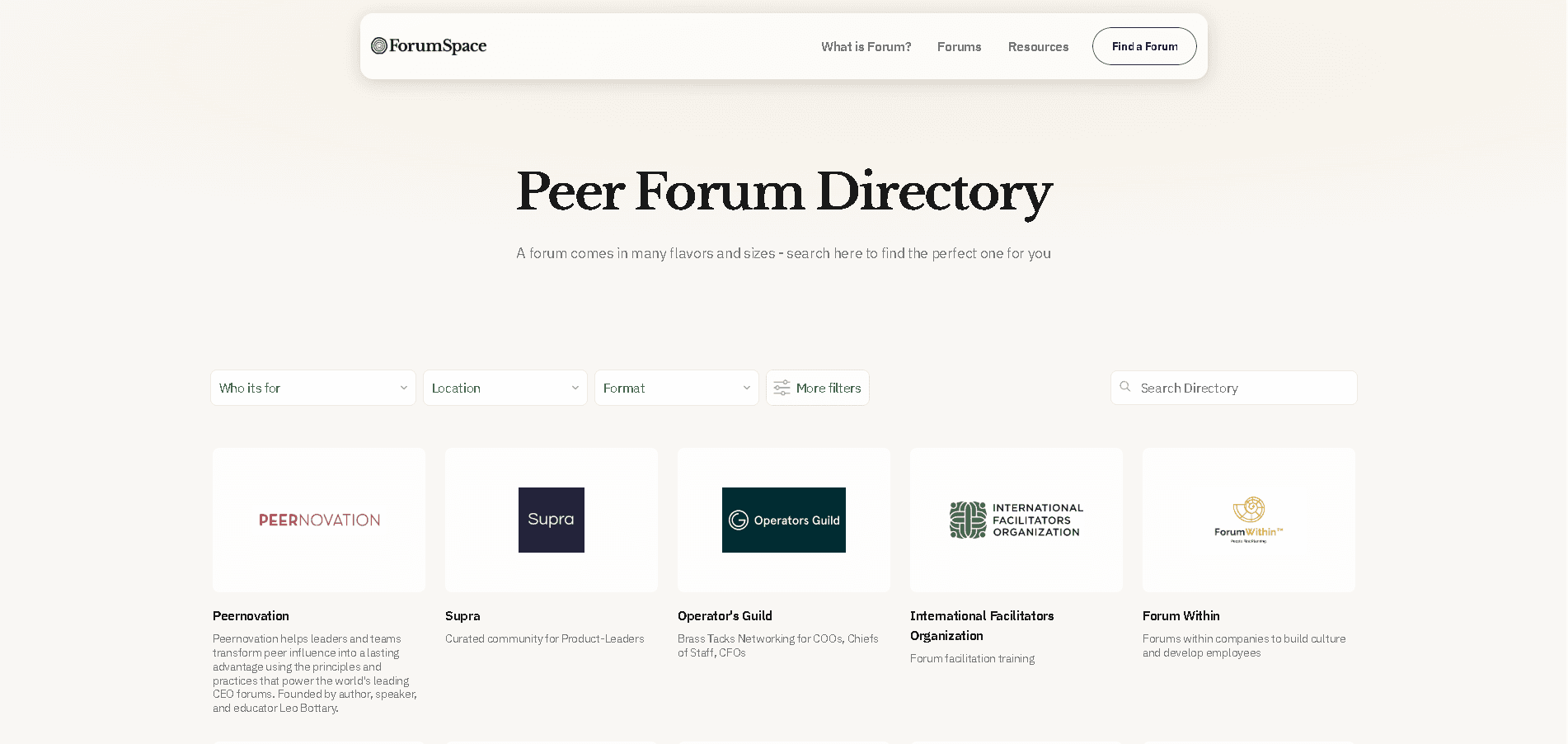
Pricing is provided on request, and companies frequently cover the expense on the leader's behalf. If this exact structure matches your goals, you can Find a Forum to take the next step.
The Conditions That Decide Whether It Works
Securing the real benefits of CEO peer groups comes down to your own approach.
The experience delivers when you commit to showing up consistently and bring raw, unresolved problems to the table. It’s important to remember that offering a sanitized version of your challenges guarantees a poor return on your time.
Furthermore, you also have to take responsibility for the room you choose to enter. An executive peer group only functions when you sit with leaders who carry comparable weight.
Also, the gathering must remain small enough to allow deep conversation, and a trained guide must properly facilitate the discussion. If any of these elements are missing, the setup stops being useful.
When the Answer Is No

Sometimes the most practical decision is simply walking away.
Participating in a CEO peer group becomes a mistake for anyone seeking highly tactical industry advice. If you need hyper-specific guidance on a niche market, a specialized trade association will serve you much better.
The setup also falls flat if your primary goal is lead generation. Executives in these meetings have zero interest in being pitched.
For building a client roster, a standard business network is the appropriate venue. And finally, leaders looking for a single expert adviser should bypass this format entirely. In that scenario, executive coaching provides the dedicated attention you actually want.
Recognizing these misalignments saves a lot of time. If you realize your current goals point toward a different model, browsing the Forum Finder directory helps you locate organizations that match your exact requirements.
How to Test It Before You Commit
Before signing any agreements, you need to verify the environment first.
The most effective way to evaluate an executive peer group is to request to sit in on a live meeting. Because experiencing the actual room dynamic firsthand reveals more than any sales deck ever could.
You also need hard facts about the room composition. Ask directly who else attends the sessions and what specific growth stage their companies are currently navigating. In addition to that, it’s equally critical to inquire about the exact methods the organization uses to enforce strict confidentiality.
Next, look closely at the person guiding the conversations. Ask who facilitates the meetings and request details about their formal training.
Lastly, check the retention rate by asking how long leaders typically stay involved. High retention is a strong signal that the setup actually delivers long-term value.
If you’re ready to evaluate a room and see this dynamic in action, you can Find a Forum to begin the process.
Frequently Asked Questions

Are CEO peer groups worth the money?
Yes, they justify the investment when you actively participate in a strictly facilitated environment. Anyone wondering if a CEO peer group is worth the money must first evaluate their own willingness to share real problems. The return drops significantly if you hold back or join a room filled with people seeking sales leads.
How much does a CEO peer group cost?
Standard peer group formats generally run between $4,000 and $7,000 annually. Premium experiences with dedicated guides typically range from $15,000 to $20,000 per year, alongside initiation fees. You should always verify the exact CEO peer group cost on the specific organization's website.
How much time do CEO peer groups take?
You should expect to block out at least half a day every month for these meetings. This recurring calendar commitment is substantial, but a structured format prevents the conversation from drifting. Showing up consistently is absolutely mandatory for the experience to work.
What is the difference between a CEO peer group and a mastermind?
A mastermind focuses heavily on rapid advice and hitting tactical growth targets. A structured peer gathering prioritizes sharing lived experiences and processing both professional and personal challenges. The main distinction is collective wisdom versus quick goal tracking.
What is the difference between a CEO peer group and executive coaching?
Coaching provides one-on-one attention from a single adviser focused entirely on your individual leadership behavior. A peer model surrounds you with multiple executives facing similar daily pressures. When choosing, determine if your need is for personal instruction versus cross-industry benchmarking.
How long before a peer group delivers value?
The benefits of CEO peer groups usually become clear after three to four consistent meetings. It takes a few sessions for the room to build genuine trust and move past superficial updates. Bringing raw, messy problems to the table accelerates this timeline significantly.
Can I attend a meeting before joining?
Reputable organizations usually allow you to sit in on a live session before making a financial commitment. Observing the actual room dynamic is the most reliable way to gauge the setup. You should always ask for this trial run to verify the quality of the facilitation.
Can my company pay for it?
Yes, employers frequently cover the fees on behalf of their nominated leaders. Companies view an executive peer group as a standard professional development investment for their senior bench. This arrangement makes the financial aspect much easier for the individual executive to navigate.
When is a CEO peer group not worth it?
The setup fails if the room lacks a trained guide or if the other executives operate at a completely different scale. It also falls flat if you need highly tactical industry advice. In those situations, you’re better off exploring other professional development routes.
Conclusion

The experience only justifies the investment when you show up consistently, bring your real problems to the table, and sit with executives of comparable weight in a properly facilitated room.
If you’re prepared for that level of honesty and structure, take the next step and Find a Forum.

Find a Forum