How to Choose A Peer Advisory Group for Executives in 2026

To choose the right peer advisory group, you must ask four important questions. The questions are:
Are the group’s objectives aligned with your requirements and expectations?
What is the calibre of the group members?
What is the promise of confidentiality of the group?
Does the group maintain its stance of confidentiality?
These questions are far more important to answer than choosing a peer advisory group only based on the website design and brand name. While these questions are very helpful, they are not ones you can get answered honestly on a sales call. So, we’ve prepared this guide and checklist for you that you can use when choosing a peer advisory group.
We’ve marked seven things worth verifying before you join, the questions that draw out an honest answer, and the red flags that mean you should keep looking. This guide will help you determine the veracity of the claims of any peer advisory group ever before you get on a sales call with their teams.
The Models You Will Come Across

Peer advisory groups cover several different formats, and they are not interchangeable. Here are the most common peer advisory group models you’re expected to come across.
Chair-Led Advisory Groups
A single paid chair convenes the group. They are charged with facilitating each meeting and usually are the one who coaches every member one-on-one between sessions. Vistage is the established example of this model. In this model, groups tend to be larger, with up to 16 executives from non-competing companies being a part of the group.
Generally, a former CEO works as the chair and runs a defined process for working through each member’s issues. The one-on-one coaching from an ex-CEO is the draw for this model, while the drawback is that a larger group gives each member less airtime. The chair’s judgement also shapes the group’s experience significantly. This can be both a pro and a con depending on the person.
Facilitated Peer Forums
These are smaller groups that meet regularly in confidence, and the operation is guided by a facilitator. Their job is to run the conversations with an emphasis on candor between peers of similar seniority. Some groups also follow a consistent structure so every member gets heard.
Instead of opting for an independent facilitator, certain organizations also run member-led versions, with EO’s Forum programme being one of the best-known examples of it. The group structure is the real determining factor in this case, as you’d need to choose between professional facilitation vs peer-run groups.
Membership Organizations with Chapters
A small home group that comes with a wider community of events, local chapters, and sometimes physical spaces. Chief, the network for senior women, is built this way. Members here sit in a small core group and also draw on clubhouses, executive courses, and a broad calendar of events.
The appeal is the expanse of these organizations, as they come with a peer group plus a much larger network members can tap. The tradeoff in this case is that the small-group element’s depth and consistency can vary significantly.
Masterminds
These are smaller and often paid groups that are organized around a particular expert, theme, or business stage. The structure of these groups can vary, as some of them are tightly facilitated while others resemble a recurring conversation with no formal structure.
A mastermind can be excellent when the members are well matched, and the convener is experienced. Since mastermind is a buzzword, it alone doesn’t describe much about any group, so make sure you perform due diligence before making a choice.
Industry Associations
Sector bodies where peer exchange sits alongside advocacy, standards, events, and training. These groups are best for leaders who want counsel rooted in particulars of one industry. The limitation of these groups is that they are rarely small, confidential, or structured.
This leads to a lapse in candid and structured discussions that the other formats thrive on. Peer support tends to be one of the primary benefits of these groups. However, as mentioned previously, it can be both a pro and a con, depending on the experience level of the peers in the group.
Seven Things to Check Before You Join

As promised, here are the seven questions you must get answers to in order to identify red flags and draw out honest answers. So, make sure you ask these seven questions before committing to any group.
Who Is Actually in the Room?
The most important driver of value in a peer advisory group is the calibre of the other members. The ideal scenario is having a group of members who carry comparable decision weight at a similar company stage. However, an important distinction here is ensuring the other group members are not your direct competitors. To learn crucial information about the group’s makeup, you should ask how members are selected. This will help you identify whether the group vets their members by seniority and fit or not. Evasive answers to questions regarding how the members are selected are also an answer and should be noted accordingly.
If you’re weighing CEO-level groups specifically, our guide to CEO peer groups goes deeper on seniority and fit.
Is Confidentiality Real?
Confidentiality matters in a peer advisory group because it enables members to discuss actual problems with numbers, real people, and acknowledge genuine mistakes without having to sanitize them. The question you need an answer to is whether confidentiality is an enforced rule for the group of your choice or is it just a line on the website.
To get an honest answer, you should ask the team about what existing members have agreed to, whether it is written down, and what happens if someone breaks the confidentiality requirements. Confidentiality promotes candor and productive conversations; it is not aimed at promoting secrecy.
What is the Group Size?
Large groups are notoriously difficult to navigate, and it leaves everyone wanting more. The group size decides how much of each meeting is actually yours. Six to eight is the tight end, small enough that every member can bring something substantial and still be heard the same day.
As groups grow past eight members, the airtime per person shrinks, and the discussions tilt toward the few who speak up. However, you should know that large groups are not always worse; the difference lies in your decision to be an active member or a spectator for most months.
What is the Quality of Facilitation?
A trained facilitator changes what the group is capable of. Think of them as a moderator who keeps conversations honest, ensures everyone gets heard, and holds the structure so that the hour is not spent on one person’s update.
More importantly, a good facilitator understands their role clearly and doesn’t hand out advice. Instead, they draw value from the peers in the room. To get a clear understanding of the standard of facilitation, ask any group you’re joining about their facilitator, what training they have, and whether the same person is there every time.
Does the Structure Hold Consistently?
Repetition legitimizes, and that’s exactly how strong groups remain successful. They run the same sequence every meeting and ensure the structure is thoroughly maintained across all meetings. While it may sound like a constraint, it is not.
A predictable structure allows candor and ensures everyone gets their turn. Without a dedicated structure, meetings drift into general conversation, and the person with the loudest problem or the loudest personality tends to win the room. To learn more about the group in this context, ask the team whether their meetings follow a set format, and what the structure is, if they do.
Does the Group Remain Professional Only or Does it Allow Personal Queries too?
This is an important distinction that you shouldn’t miss in your search for the ideal peer advisory group. Some formats are built to handle business problems only, such as strategy, hiring, and business numbers.
Other groups open up their discussions from professional to personal as well since both are considered inseparable in most cases. None of these approaches triumph over the other. Decide which you want before you join because this is a fundamental differentiating factor, which can limit the value you receive from the group.
What is the Eligibility, Cost, and Commitment Requirement for the Group?
Most groups have specific eligibility criteria for members, be it a seniority requirement, business revenue threshold, or a subscription cost. Before you move ahead with any particular group, it is important that you check whether you clear their eligibility criteria or not.
Once that’s done and you know that you qualify, ask more about how often the group meets, how long meetings generally are, and what is expected of you in each meeting. In terms of cost and prices, make sure you verify directly against the provider’s own material since these figures are subject to change without notice. Always verify pricing information directly from the source over older articles or third-party summaries.
How ForumSpace Approaches This?
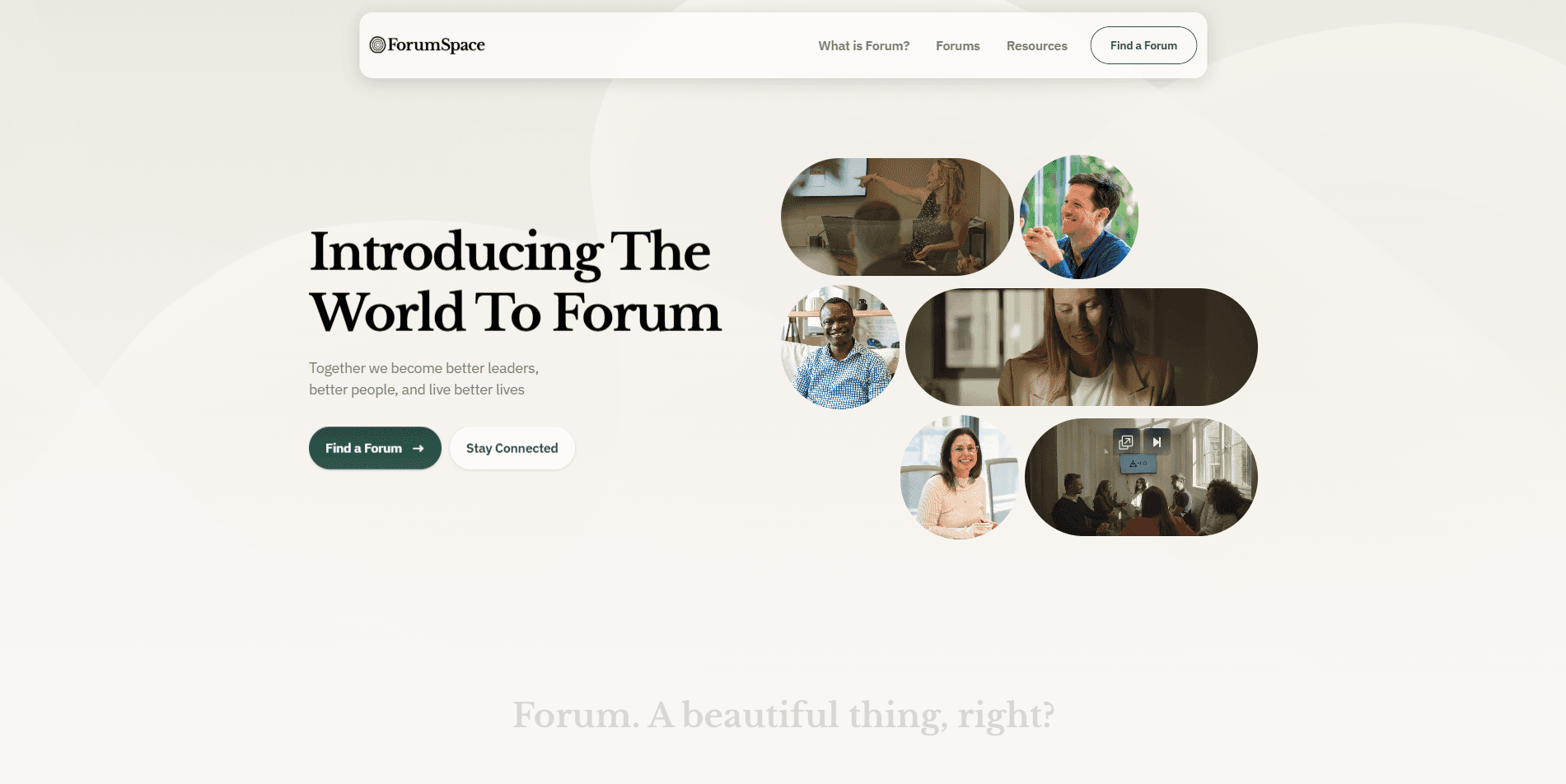
ForumSpace runs facilitated Forums for senior leaders. A Forum, in the ForumSpace sense, is a small group of six to eight people who meet regularly, in confidence, with a trained facilitator. The group works through professional and personal challenges they are facing. Members either join because their company has nominated them or they approach ForumSpace directly.
What ForumSpace Provides?
To ensure members get the most value, ForumSpace provides:
Trained facilitators
Structured Forum methodology, so every meeting follows the same sequence
Onboarding education, so members arrive prepared rather than confused
Custom-built technology
Ongoing support
Curated insights, tools, and resources
What Distinguishes It?
Set against the seven checks, a few things stand out. The professional and personal are both in scope, which is a good thing because professional problems seldom stay neatly inside work. The group is always led by a trained facilitator rather than left to run itself.
This keeps meetings consistent and valuable for every member. Also, ForumSpace keeps groups small with a maximum of eight members on a fixed cadence. This protects airtime. Additionally, the structure holds because every meeting follows the same sequence: a short settling exercise, then an opener, then a clearing round, and then updates.
This repeated sequence keeps everyone in the know for what comes next. Lastly, onboarding happens before any member’s first meeting to ensure they arrive ready to take part actively.
Who It Suits and Who It Does Not
It suits senior leaders who want ongoing, confidential counsel from people carrying similar decision-making authority. It is also important to note that professionals who aim to show up for the meetings are best suited to join one; passive membership is not only less valuable, but it also reduces the value other members receive from the group and each meeting.
If you’re looking for tactical industry-specific advice, a route to generate business, or a single expert adviser rather than a room of peers, another format will suit your requirements better. A chair-led group or an industry association fits the first case, and a mastermind or a coach fits the last. The Forum Finder directory lists other Forum organizations if you want to look across the category.
Pricing
Pricing for ForumSpace is provided on request, and companies frequently cover it on the leader’s behalf. If a Forum sounds like the right fit for you, make sure you follow through the next step, which is to Find a Forum.
Red Flags

A few answers should make you slow down. While a sales answer doesn’t definitively ensure a group is good or bad, each is a reason to ask harder questions before you commit. Some of the most crushing red flag answers are mentioned below.
Vague answers about who is in the group: If a provider cannot tell you the seniority, stage, and rough profile of its members, either they don’t know, or they would rather hide that information. In any case, this is a major red flag since the composition of the room is the product, and a straight answer here is the minimum.
No vetting: If the group admits anyone who is willing to pay, that greatly minimizes its fit. Such groups optimize for revenue, and in most cases, these groups do not have any assurance of whether the people around the table can actually help you or not. For peer advisory groups, the value of peer counsel comes from the filter that decides who gets in.
No facilitator, presented as a feature: Marking the lack of a facilitator as a feature equates to promoting an unmoderated debate or Q&A. A member-led group can be valuable too, but you must know that it is what you’re joining. If nobody is responsible for keeping the structure and the candor intact, the group tends to drift toward the loudest voice and the easiest topics.
A group that functions as a sales channel: If the members are quietly present to sell to one another, the counsel is compromised, because no one gives honest advice to a prospect. To get an honest answer in this regard, ask the group whether members do business with each other or not. Watch how this question is received.
Heavy upfront commitments without any way to try it: Groups that ask for a long contract and a large payment before you have seen a single meeting is a lot to ask on trust. A credible group will let you sit in, or at least meet the facilitator and understand the format, before you sign.
Anyone promising specific business outcomes: If a peer counsel markets that they can sharpen your thinking and widen your options, that’s an honest outcome. However, if they’re promising specific revenue figures, a valuation, or a timeline, they are misleading in most cases because a peer group does not deliver on any of these promises.
How to Make the Decision?

The best way to make a decision is to work back from your situation rather than working forward from any provider’s pitch. The first step is to start with the reason you want peer counsel in the first place. It is okay to be honest and answer yourself.
If your goal is to find sharp, tactical input on running your business from someone who has it, a chair-led group with an experienced chair is a strong fit. Similarly, if you want counsel rooted in the particulars of your sector, an industry association or a vertical-specific group will speak your language.
Lastly, if you want a single expert to advise you directly, that is a coach or a consultant, not a peer group at all. These distinctions matter and are exactly the questions that help you make a decision in the end.
Continuing on the decision-making matrix, if you want an ongoing, confidential group of peers carrying comparable weight, where the professional and the person both have room, that points towards a small facilitated Forum.
Otherwise, if breadth matters as much as depth, a membership organization with a wider network around the core group may suit you better than a standalone group.
Different readers land in different places, and that’s exactly the point. There is no single best option here. The best fit for your situation, your seniority, and how you want to spend your time depends solely on you. The key is to create a shortlist first and run the seven checks against each one on a call.
To help you create the shortlist, the Forum Finder directory is a useful asset to look across the category and see the range of Forum organizations in one place before you decide.
Frequently Asked Questions
What is a peer advisory group?
A peer advisory group is a small group of senior leaders who meet at fixed intervals to advise one another on real decisions. Most are facilitated and most run under strict confidentiality. This is done to ensure members can speak candidly about things that they cannot easily share inside their own organizations. The term covers several group formats, from chair-led groups to smaller facilitated peer groups.
How do I choose the right peer advisory group?
To choose the right peer advisory group, make sure you work back from your requirements. To understand your requirements, ask yourself why you want to join a peer advisory group in the first place. Members join for a variety of reasons, and none triumphs over the other. Based on your answer, you’ll be able to understand the group format that suits your needs appropriately. From there, you can create a shortlist and ask each team the seven checks discussed in this article.
How much does a peer advisory group cost?
The cost of a peer advisory group varies widely based on its format and seniority. It is crucial to note that even though exact dollar values are presented in third-party reviews of peer advisory groups, they may not reflect true costs since the figures are subject to change at any time. It is best to get a quotation from the groups you want to participate in directly to get accurate pricing information.
How big should a peer advisory group be?
A peer advisory group should be small enough that everyone gets meaningful airtime while also being big enough to hold a wide set of perspectives. The sweet spot most commonly used by groups is six to eight members. This ensures that every member can bring something substantial to the group while also being heard at every meeting. Even though six to eight members is considered a sweet spot, there are countless examples of groups with more or fewer members being equally successful. So, keep in mind that there’s no one right answer in this regard.
What is the difference between a peer advisory group and a mastermind?
A peer advisory group is usually facilitated and structured. It hosts vetted members of similar seniority. Masterminds are often looser and organized around a particular expert, theme, or business stage. It doesn’t generally have an independent facilitator. No one option is better than the other. The right choice depends on whether you want structured peer counsel or a more informal information exchange.
What is the difference between a peer advisory group and a Forum?
A Forum in the ForumSpace sense is a specific format within the broader peer advisory group category. It is a small group of up to eight leaders who meet regularly in confidence with a trained facilitator to work through both professional and personal challenges. The whole-person scope and the trained facilitator are the differentiating factors here.
Do peer advisory groups have eligibility requirements?
Yes, many peer advisory groups have eligibility requirements. This can be in the form of a business revenue threshold, a seniority requirement, a vetting process designed to keep members well matched, or even a hefty membership fee. It is important that you ask each group about the criteria early to determine whether you clear it or not before investing more time in a conversation.
Can I attend a meeting before joining?
In some cases, yes, you can attend a meeting before joining. However, it is important to ask this directly to the group’s team at the time of your conversation. A credible group generally lets you sit in as a guest or at least meet the facilitator and understand the format before you sign anything. This visit is due diligence on your end, so make sure you treat it as such.
Can my company pay for it?
Yes, in many cases, companies cover the membership cost for their leadership to join peer advisory groups. In many cases, the company nominates leaders into a group directly. If you’re considering a specific group, it is crucial that you ask your organization whether this is something that it would be willing to support or not.
Conclusion
Making your choice for a peer advisory group in 2026 comes down to the seven checks mentioned in this article. You must ask: who is actually in the room, whether confidentiality is real, the group size, facilitation quality, whether the structure holds, professional-only support, and lastly the eligibility and cost of membership. These questions will help you gauge every group based on how readily you receive each answer from the team.
In the end, please note that there is no single right answer here. There is only the right fit for your situation and your seniority. If a small, facilitated, whole-person group is what you’re looking for, you can Find a Forum.

Find a Forum